


A healthy nail plate is always transparent, colorless and smooth on the surface.Namely, it looks pink due to the capillaries located under the nail plate, shining through it.But for some reason, sometimes white or yellow spots begin to appear in the thickness of the nail, as they grow, they take the form of longitudinal grooves.Slowly moving from the free edge to the cuticle, they will gradually acquire an arrow-yellow color.Fungal damage to the nails.Interacting with each other and increasing in size, they can occupy the entire nail plate up to the back nail layer.Due to the development of horny masses in the area of the nail bed, the nail becomes thicker, the free edge of the nail can be separated from the nail bed.Soon the shine of the nail disappears and the free edge becomes rough.In some patients, the nail plate may separate from the bed, revealing a collection of colloidal masses.The color of the affected nail plates varies from yellow-brown to gray.
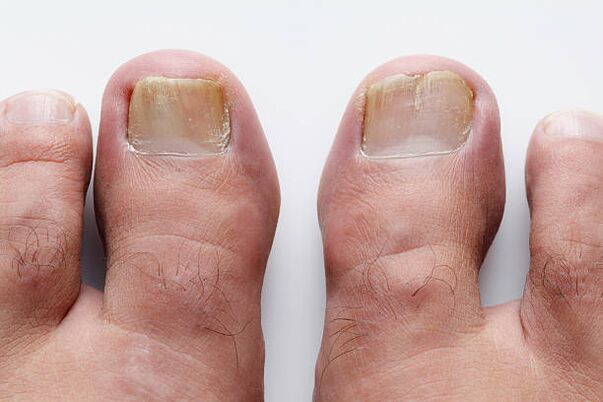
All described changes most often occur with onychomycosis.The term appeared in 1854 to refer to nail lesions caused by pathogenic fungi.Onychomycosis is a very common nail disease;found in 10-20% of people.Fungal infections of the feet are more common in countries with colder climates.But uncomfortable and tight shoes, regardless of the climate, create favorable conditions for the development of infection.The risk of contracting onychomycosis increases with age, so onychomycosis is more common in older people.Sources of fungal infections are swimming pools, gyms, public showers, bathrooms, locker rooms, dormitories, uncomfortable shoes that squeeze the feet, arterial or venous insufficiency, immunodeficiency, diabetes.And, of course, you can get infected at a pedicure or manicure salon.Onychomycosis of the hands, caused by yeast-like fungi, is more common in women who keep their hands in water or soapy water for a long time, or who work with sugar, dairy products, or antibiotics.
In most cases, nails are affected by dermatophytes, often fungi such as yeast, and less often by molds.The main causative agent of onychomycosis is dermatophyte fungi.Their share is up to 90% of the total mass of fungal infections.The most common pathogens of onychomycosis are T. rubrum (about 80% of cases) and T. mentagrophytes.Interdigitale (10-20%).As a rule, they first affect the spaces between the fingers, and then the nails themselves.Therefore, it is important to prevent skin infection.Candidiasis can come into contact with foods rich in carbohydrates.Also, mold fungi live in the soil, so the causative agent of mold onychomycosis is in the external environment and often attaches to the already modified nail.Many scientists believe that this disease is less contagious.
The clinical distribution of onychomycosis is associated with the possible penetration of the fungus into the nail.Distal lateral subungual, white surface, proximal subungual and total dystrophic onychomycosis are distinguished.Often, pathogenic fungi are located in the subungual cavity.From here they can penetrate the nail bed.Under the influence of dermatophytes, the epithelial cells of the nail bed produce soft keratin that lifts the nail plate when it accumulates.Hyperkeratosis is characterized by a whitish color of the lesion.Soft keratin promotes the growth of fungi - a vicious circle is formed.The nail plate, which is composed of hard keratin, does not change at first, but later the dermatophytes create a network of air tunnels, and when this network becomes abundant enough, the nail loses its transparency.Often, the infection spreads along the longitudinal grooves of the nail.Infection of the matrix - the growth zone - with fungi causes various dystrophic changes in the nail.
Rubromycosis (caused by T. rubrum) affects the toenails and often the hands.More than 90% of patients experience increased dryness and increased keratinization of the skin of the hands and feet.Nail plates can be covered with white or yellow spots and stripes, while maintaining their shape and size.There is no concern about this disease, and patients do not always feel these changes (normotrophic type).With the hypertrophic type, significant thickening of the nail plates is possible due to the accumulation of horny masses under them.They are dull and break easily.With such changes in the nail plates, patients often complain of pain in the toes when walking.Nails with rubromycosis are significantly thickened and curved, resembling bird claws (mycotic onychogryphosis).With an onycholytic type of lesion, the nail plates become thinner and often separate from the nail bed on the side of the free edge at the beginning of the process.The separated part becomes dull and often acquires a dirty gray color.The proximal part of the nail, especially those closer to the lunula, retains its natural color for a long time.In the open areas of the nail bed, hyperkeratotic layers, quite loose masses are formed.
Athlete's foot often develops in patients with excessive sweating of the feet.Athlete's foot most often starts on the side of the free or lateral edges of the first or fifth toe.Athlete's foot (T. mentagrophytes var. interdigitale) is one of the most aggressive fungal pathogens of hornet infections.
Yeast fungi Candida spp.representatives of normal human microflora.European studies show that candida infection causes onychomycosis of the feet in 5-10% of cases and in 40-60% of cases of the hands.The disease occurs when the immune system is weakened and the normal composition of the microflora is disturbed.Candidal onychomycosis develops more often in people suffering from diabetes mellitus, obesity and decreased thyroid function.With candidiasis, redness and pain of the nail folds precedes damage to the nail plates.Inflammation, changes in shape and thickening of the ridges cause the cuticle to separate from the surface of the plate.As a result, the fungus enters the nail matrix and from there penetrates the plate and nail bed.Along with paronychia, onychomycosis is also observed with non-dermatophyte infections, for example, streptococcus.
More than 40 species of mold fungi are known, the causative agent of onychomycosis.Some of them are soil dwellers, found everywhere in the environment and affect healthy nails.But more often, already changed nail plates become infected.These changes may be caused by dermatophytes or may be caused by one of the many degenerative processes that cause deformity, most importantly, disruption of the microstructure of both the nail bed and the nail itself.
Onychomycosis, caused by a mold fungus, usually appears on the feet.The clinical picture may externally correspond to changes in various dermatoses, for example, psoriasis, which leads to diagnostic errors and ineffective treatment.Therefore, it is necessary to conduct laboratory tests.The affected part of the nail plate is treated with special solutions and examined using a microscope.The diagnosis is confirmed when filaments of a pathogenic fungal mycelium are detected.The type of pathogen is determined by growing a fungal culture in a nutrient medium.
Onychomycosis does not go away on its own.If left untreated, the infection can quickly begin to affect the nails one by one.Special external and systemic (oral) antifungal preparations are used for treatment.
Treatment of fungal nail infections
According to data, the nail plate on the hands grows 2-4.5 mm per month, and on the feet one and a half times slower.A full nail plate can grow on the hands in 4-5 months, and on the feet in 11-17 months.Nails on different fingers grow at different rates;The nails of the big toes grow longer than the others.Since nails grow slowly, there is no need to pay attention to the external condition of the nails when analyzing the effectiveness of the treatment course;the obtained result can be determined only after receiving the results of microscopy tests and culture.If culture or microscopy results are negative, systemic antifungal agents should not be used more than recommended by the guidelines.Otherwise, you can either continue the treatment or change the antibiotic.External therapy creates a protective layer on the nail surface with a high concentration of antifungal agent.The main advantage of local therapy is safety, lack of toxicity and side effects.
The disadvantage of local external therapy is that the drug does not always reach the causative agent of the infection - the fungus located on the nail plate and matrix.To destroy the pathogen, the nail plate is removed or drugs are prescribed to soften it.Medicines used externally, for example, varnishes, can be effective only in the early stages.They are used for several months.When the nail matrix is damaged, local treatment for onychomycosis is ineffective.Moreover, patients do not always systematically follow the doctor's instructions.If the nails are mostly affected, systemic agents should be prescribed.
With a systemic approach to treatment, drugs will penetrate the surface of the nails through the blood.Many of them accumulate in the matrix and remain there even after the end of the treatment.The limitation of systemic therapy is the development of side and toxic effects, for example, hepatitis associated with long-term, months of drug use.Systemic therapy is not recommended for pregnant or lactating women, people with liver disease or drug allergies.Currently, modern antifungal drugs and advanced methods of their use have appeared, so the risk of side effects and toxic reactions has been significantly reduced.Although there are still cases of ineffective therapy.More often, they are associated with simultaneous infection of the nail plate with various types of pathogenic fungi, insufficient concentration of the drug in the nail plate (due to impaired absorption of the drug in the patient's gastrointestinal tract, diabetes, obesity, poor blood flow in the extremities), or the patient's failure to take the drug.
When choosing a systemic or local treatment, it is important to take into account all concomitant diseases, the body's resistance, the condition of the blood vessels of the extremities and metabolic characteristics.Without improving your general well-being, it is very difficult to achieve quick and quality results in the treatment of onychomycosis, to prevent relapses and re-infections.
To reduce the frequency of onychomycosis, it is necessary to carry out timely treatment of fungal diseases of the skin, not to wear other people's shoes, to control the hygiene of the skin of the feet, to take a shower in gyms, swimming pools and similar institutions, and to use local antifungal drugs.It is necessary to keep common areas clean, as well as conduct preventive examinations of personnel and visitors.It is impossible to treat patients with onychomycosis in manicure and pedicure rooms.Equipment needed to work with clients should be sterilized and use disposable materials as much as possible.